
Big life transitions, like retirement, can raise a new question about purpose. For many, whether contemplating or currently transitioning in life or work, the question isn’t just “What do I do with my time now?” It’s “Who do I do it with?”
At the Shepherd’s Center of Northern Virginia (SCNOVA), the answer many volunteers land on isn’t a hobby or a bucket-list trip, but rather activities that offer meaningful time to connect with others in a very intentional and purposeful way. It’s the regular Thursday morning ride to a medical appointment, a familiar face at the door, and a conversation that picks up right where it left off last week.
Finding Purpose After the Career Ends
Jack Roney has been volunteering with SCNOVA for about three years. He first heard about the organization at a local presentation on ways to give back in Fairfax County, and something about it resonated with him.
“It’s really satisfying,” Roney says. His favorite part is the people — how interesting and appreciative they are. Roney has plenty of regular riders now, and it shows — they often hand him a cold soda or a snack when he picks them up, sometimes even something homemade.
“We help people stay in their homes,” he says. Roney went through something similar himself years earlier, when his own parents were aging, and he was trying to help them stay independent for as long as possible. That experience shapes how he sees his volunteer rides today: a way of extending both the financial and emotional support that keeps older adults in the homes and communities they know. The participants he drives still have sharp minds and a strong desire to socialize — they’ve simply had to make the hard choice to stop driving due to a physical limitation or medical condition.
“This Isn’t Uber”: Relationships Are the Point
Ask Roney what makes SCNOVA different from a rideshare app, and he doesn’t hesitate.
“This isn’t Uber,” he says. It’s not a transaction. The ride itself often feels secondary to the two-way conversation that unfolds along the way. Picking up a few rides a week or a month creates an opportunity for real social interaction between two people who, more often than not, are on a first-name basis by the third or fourth trip.
Connection is something volunteers with SCNOVA sign up to give, but it’s also something they crave, too.
A Two-Way Street: Tom Painter’s Story
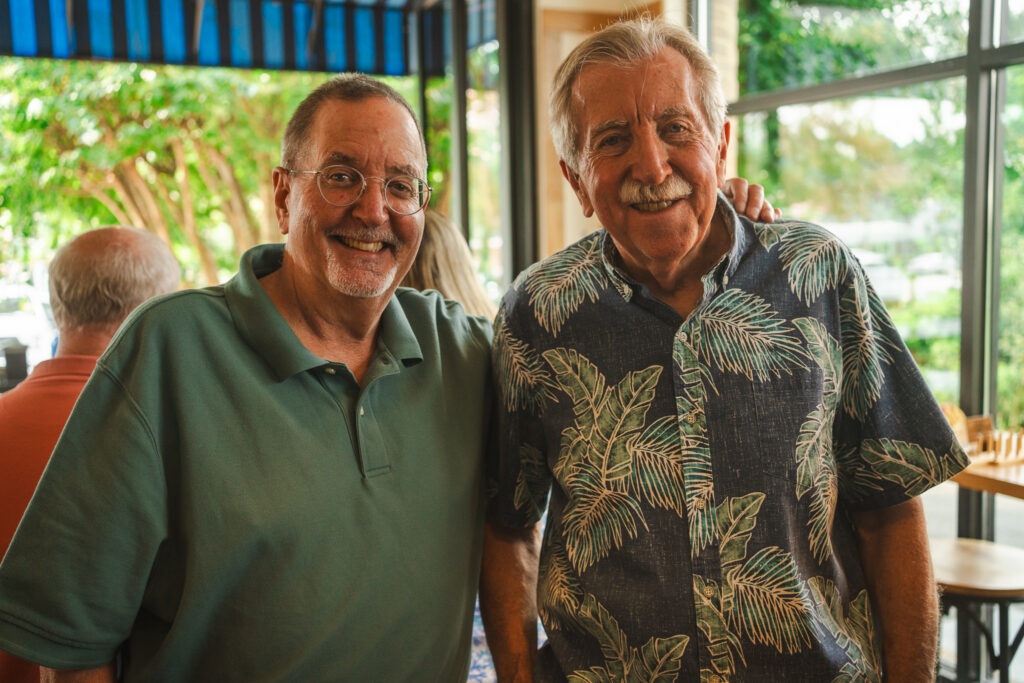
That became clear when Roney caught up with fellow SCNOVA volunteer Tom Painter at our August Volunteer Social at Bear Branch Tavern.
Painter spent his career running HR departments before retiring, and he’ll be the first to admit retirement came with a rude awakening. Without the office’s daily rhythm, he found himself genuinely missing the conversation and connection once he stopped coming in.
Today, SCNOVA is one of three volunteer organizations Painter is involved with, and he’s candid about why: it’s as much for him as it is for the people he drives.
“The social conversation is as important to me as it is to them,” he says.
That mutual comfort is what Painter thinks sets driving apart from his other volunteer work. “To me that’s what makes a difference to us as drivers — people feel very comfortable talking to us,” he says.
Every few months, SCNOVA also hosts a Volunteer Social — like the one where Roney and Painter compared notes — where drivers, friendly visitors, and program volunteers get together to swap stories, share what they’ve learned, and build friendships with one another, not just with the people they serve.
“Shepherd’s Center really sets a new bar for keeping volunteers connected,” Painter says.
Photos: August Volunteer Social
How Free Rides Keep Adults Independent
The stories are personal, but the impact is bigger than any one ride. Nationally, roughly one in five adults aged 65 and older no longer drive, whether for health or economic reasons, and in a recent national survey, 64% of older adults cited a lack of transportation and access to medical care as major barriers to their health and well-being.
SCNOVA’s own numbers tell the same story locally. In 2025, volunteers provided more than 2,700 rides and logged over 14,000 miles across Vienna, Oakton, Dunn Loring, Reston, Herndon, Great Falls, and parts of Fairfax — and 77% of those rides were for medical needs such as primary care doctor visits, physical therapy, and ophthalmology appointments. Beyond transportation, volunteers made over 500 Friendly Caller and Friendly Visitor connections and 26 Handy Helper visits for home repairs, yard work, and tech help.
None of that happens without people like Roney and Painter. In 2025, 128 SCNOVA volunteers gave more than 8,400 hours of their time — service conservatively valued at $289,128. And it appears to be working: 97% of SCNOVA participants reported feeling more positive, more secure, and more connected to their community as a result of the program.
As one transportation participant put it: “I consider your drivers angels and a Godsend. Everyone has been so caring and has made me feel safe and sound.”
The Research Backs It Up
Roney and Painter’s experience — that the connection matters as much as the errand — isn’t just anecdotal. It lines up with a growing body of research on healthy aging.
The CDC reports that roughly one in three adults say they’ve felt lonely in the past year, and older adults who live alone, manage chronic illness, or lack transportation are especially vulnerable to the effects of isolation. At the same time, McKinsey Health Institute’s global research on healthy aging found that a sense of purpose and meaningful connection with others are among the strongest factors behind older adults’ health and happiness — often mattering more than the specific activity itself, whether that’s paid work, volunteering, or something else entirely. The same research points to Harvard’s decades-long Study of Adult Development, whose director has said that warm relationships, more than any other factor, predict who stays healthy and happy into old age.
With this in mind, SCNOVA volunteer drivers and friendly callers or visitors are making a real impact on neighbors in their communities, one Tuesday morning ride or one familiar greeting at a time.
Join the Community
If you’re looking for that same kind of connection, searching for new purpose in retirement, or wondering how you can help older adults stay independent while building new friendships, consider volunteering with SCNOVA. Volunteer Application.